
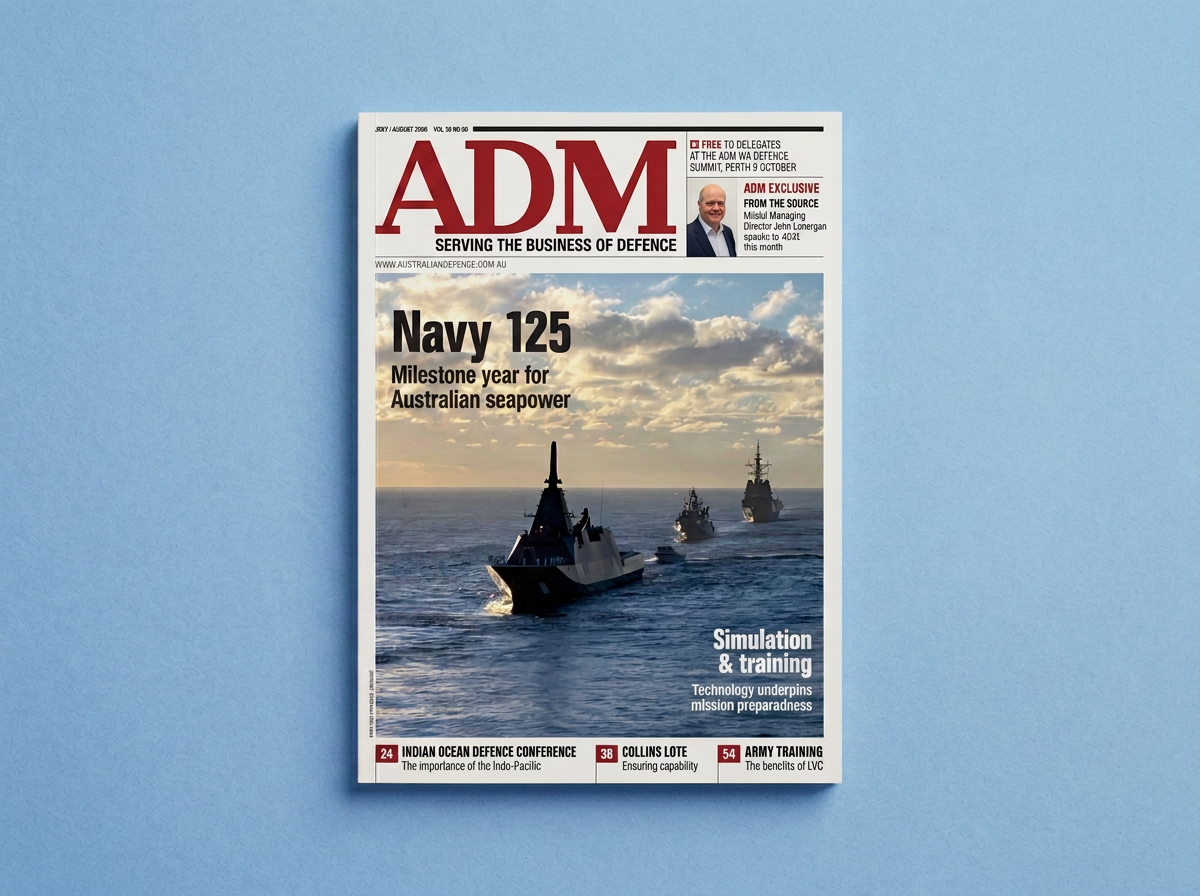
August EditionAustralian Defence Magazine
Live exercises are expensive, slow to plan, and hard to repeat. Simulation fixes all three — without replacing the training that still has to happen in the real world.
That's the core argument in Improving Readiness Through Simulation, a feature in the August 2026 issue of Australian Defence Magazine by Grant McHerron. Operator XR CEO Wayne Jones is one of the industry voices featured, alongside Company-X and BAE Systems OneArc.
THE PROBLEM WITH LIVE-ONLY TRAINING
Multi-national exercises like Pitch Black and Talisman Sabre take years to plan. The US Red Flag series needs a dedicated squadron just to run it. That's before accounting for the cost of aircraft, vessels, and personnel availability.
VR and AR close that gap. Full-scale environments — buildings, vehicles, terrain — can be built once and run as many times as the training demands, at a fraction of the cost of a live rotation.
TRAIN WHERE THE WORK HAPPENS
As Jones puts it in the article: "Because we've brought training into the tech environment, we can train a lot more readily and people can train where they work. Not having to travel for training reduces logistics and administration costs but also means more repeatability, allowing our customers to train more frequently."
That repeatability is the point. Ten or twenty simulated runs before a live evaluation means uniformed personnel walk in with muscle memory already built — not learning a process for the first time under real conditions.
REAL WEAPONS, REAL DATA
The article highlights a principle Operator XR was founded on: everything used in a fight has to be used in training. Real weapons, real triggers, real comms — recreated with air-recoil systems that deliver genuine trigger pulls and recoil with zero risk of injury.
Jones also points to after-action data as one of the most underused parts of simulation: "There's a lot of data that we can obtain from an after-action review system making it a very powerful part of the tool. Are they looking all over the place and not focusing on the right things? We can identify the biggest distracting areas and guide trainees on where to look during scenarios such as when they're conducting an assault, a vehicle stop, or dealing with an active armed offender."
COUNTER-UAS: A GROWING PRIORITY
With uncrewed systems now a constant presence on the battlefield, the article covers how simulation trains personnel to detect, identify, and counter drones before they ever face one live. Operator XR's own drone-attack scenarios put trainees through the sounds, movement patterns, and decision points of a real UAS threat — including when not to give away a position by engaging.
SIMULATION SUPPLEMENTS. IT DOESN'T REPLACE.
Every operator quoted in the piece — Jones included — makes the same point: simulation is one part of the training continuum, not a replacement for classroom instruction or live exercises. Used well, it's what makes the live component more effective, not less necessary.
Read the full article for the complete picture on VR/AR force readiness, mission rehearsal, and where simulation is heading next.